
How a few foundations shape academic culture
By Tao Tan
January 23, 2026
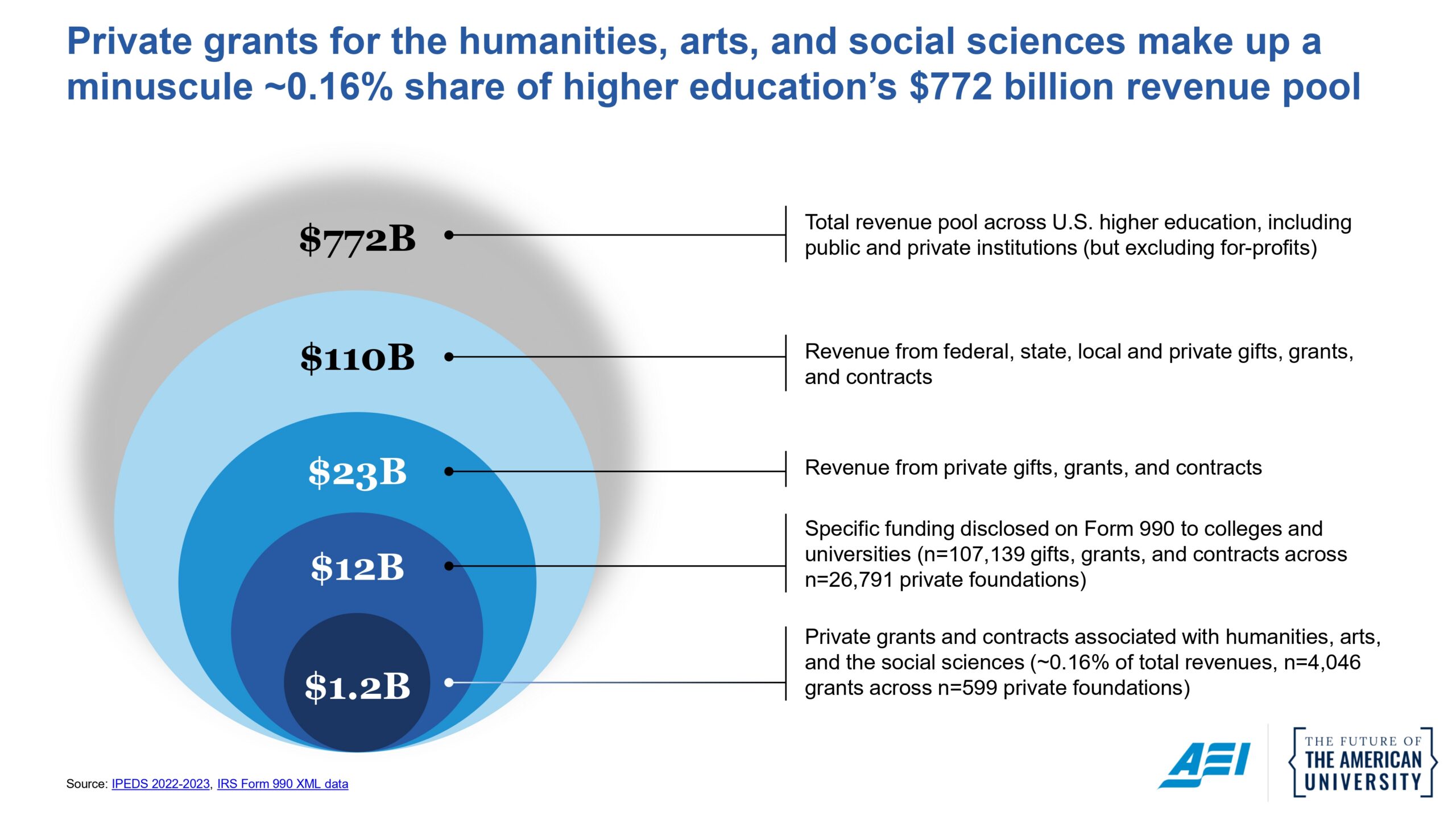
A surprisingly small stream of private money may play an outsized role in shaping academic culture in American higher education. Out of higher education’s $772 billion revenue base, just 0.16% of that, or roughly $1.2 billion per year, flows to the humanities, arts, and social sciences (HASS) from U.S.-based foundation funding.
Yet in fields with little alternative support, a narrow stream carries disproportionate weight. Because funding is both scarce and highly concentrated in HASS, a small number of foundations can exert meaningful influence over which questions, methods, and research framings are most likely to be rewarded. Only a fraction of this funding discloses a political or ideological leaning, but even that minority can shape marginal incentives, expectations, and career paths.
A little bit goes a long way
To understand how culture is formed in academia, start by following the money. This analysis draws on a large language model–assisted review of more than 600,000 Form 990 filings from 2023, identifying over 107,000 grants, contracts, and gifts to universities from nearly 27,000 foundations, totaling about $12 billion. About a tenth of that was earmarked for the humanities, arts, and social sciences.
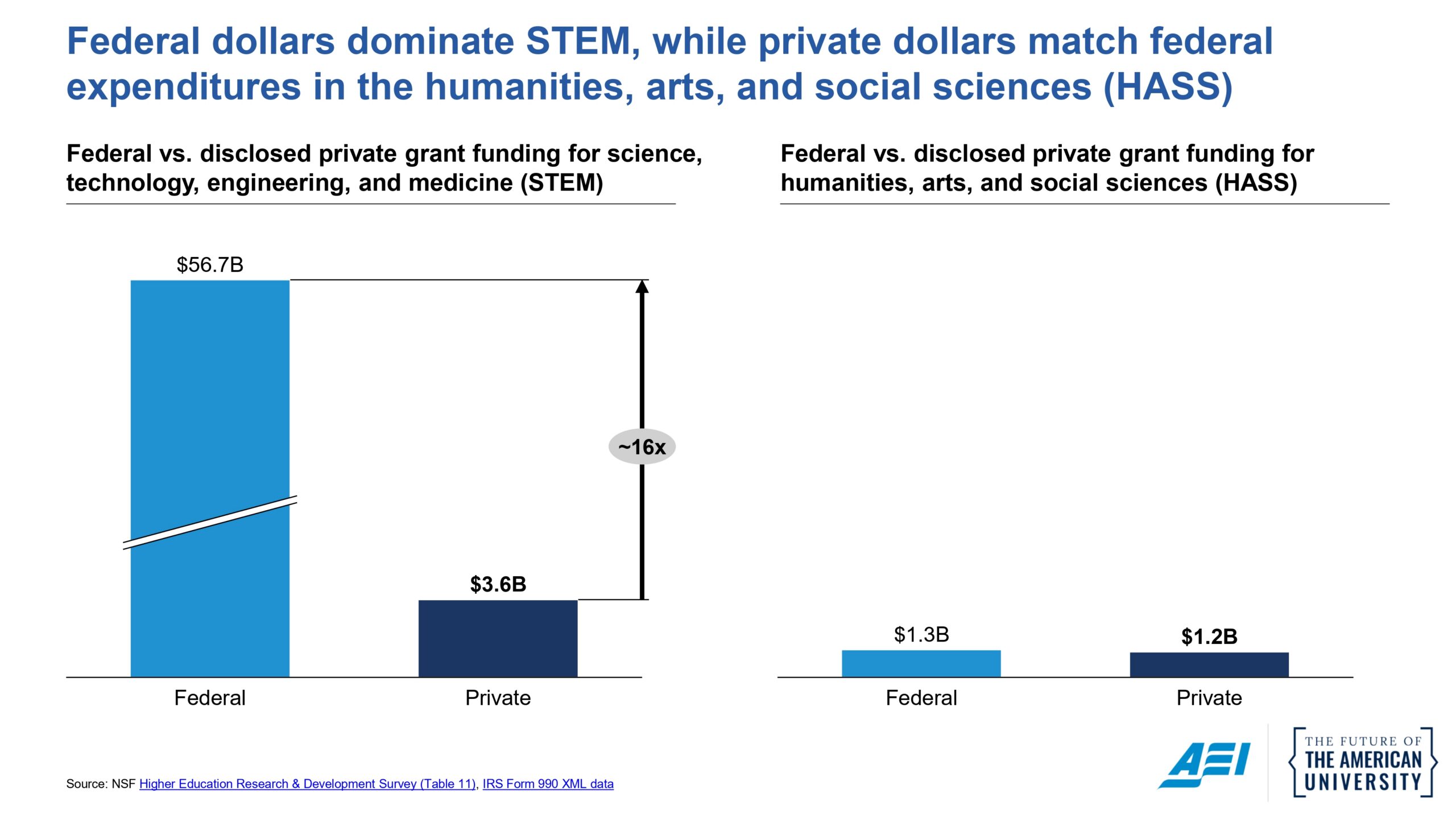
This modest sum exercises outsized influence because of scarcity. In science, technology, engineering, and medicine (STEM) fields, federal funding dominates private grants 16 to 1. In the humanities, arts, and social sciences, private grants are even with federal sources.
The disparity in federal commitments is stark. The National Endowment for the Humanities (NEH) and the National Endowment for the Arts (NEA) together had a budget of $400 million in 2023. The National Institutes of Health’s (NIH) budget was $48 billion. In other words, the NIH spent the combined NEH and NEA budget every three days.
The difference extends beyond money to strategy. In STEM fields, the White House Office of Science and Technology Policy actively coordinates federal research priorities across agencies according to clear national objectives. HASS fields have historically lacked any equivalent coordinating function. Instead, dozens of federal agencies made scattered grants without strategic direction or oversight. No single entity tracked total HASS funding across government, much less set priorities for it.
This scarcity flips the normal funding dynamics on their head. In STEM, federal agencies lead with abundant resources while private philanthropy follows; in HASS, private foundations lead while fragmented federal funding follows.
This scarcity is compounded by concentration. Nearly 80% of disclosed private funding for HASS fields comes from just 25 foundations. Many of the names are well-known: Mellon, Open Society, Duke, Knight, and Ford.
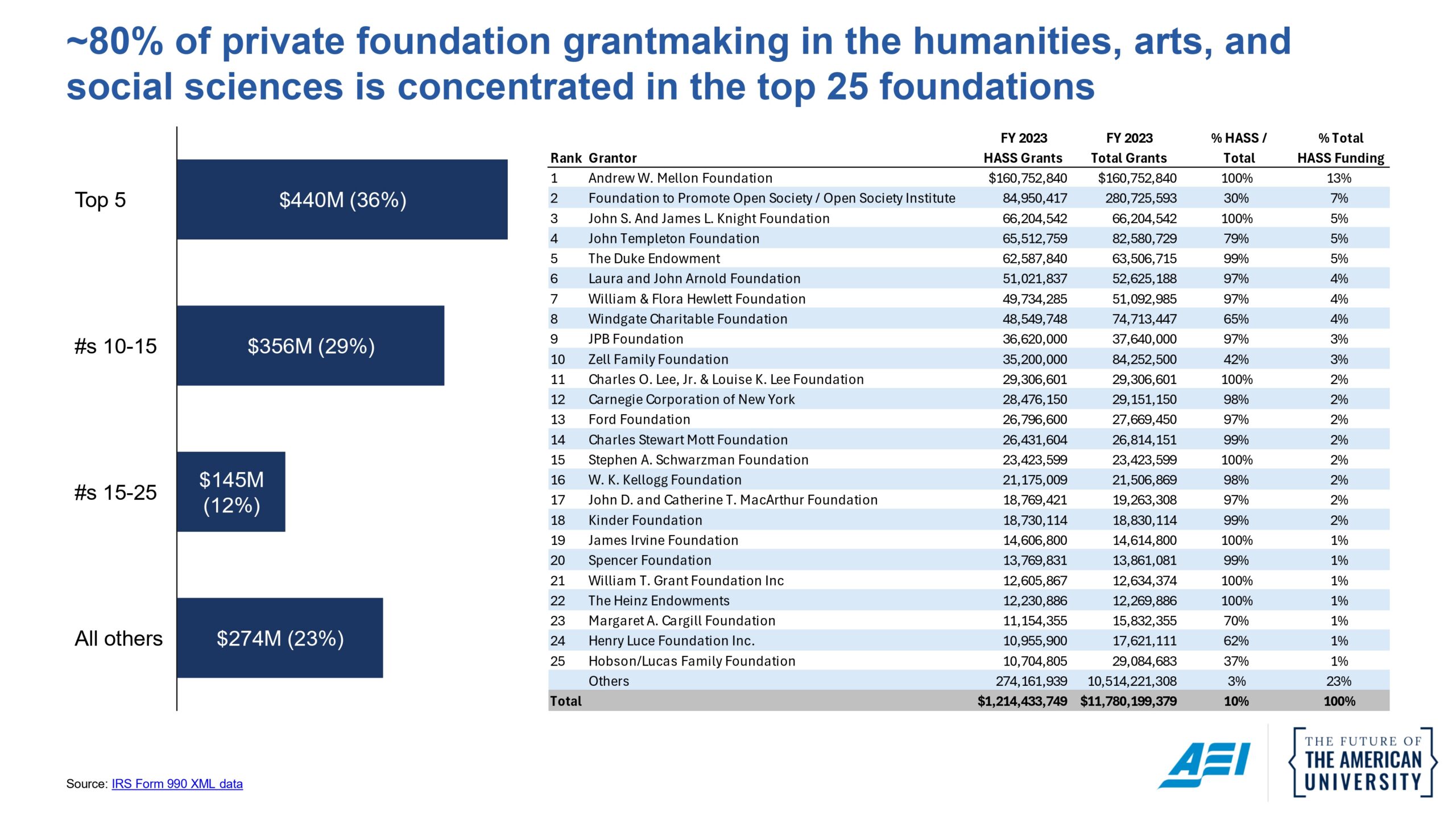
Regardless of any foundation’s particular priorities, when 25 institutions control nearly 80% of disclosed private funding in a resource-scarce field, those institutions can exercise what might be termed “standard-setting power:” they define the fundable, shaping which questions, methods, language, and research framings are most likely to attract support.
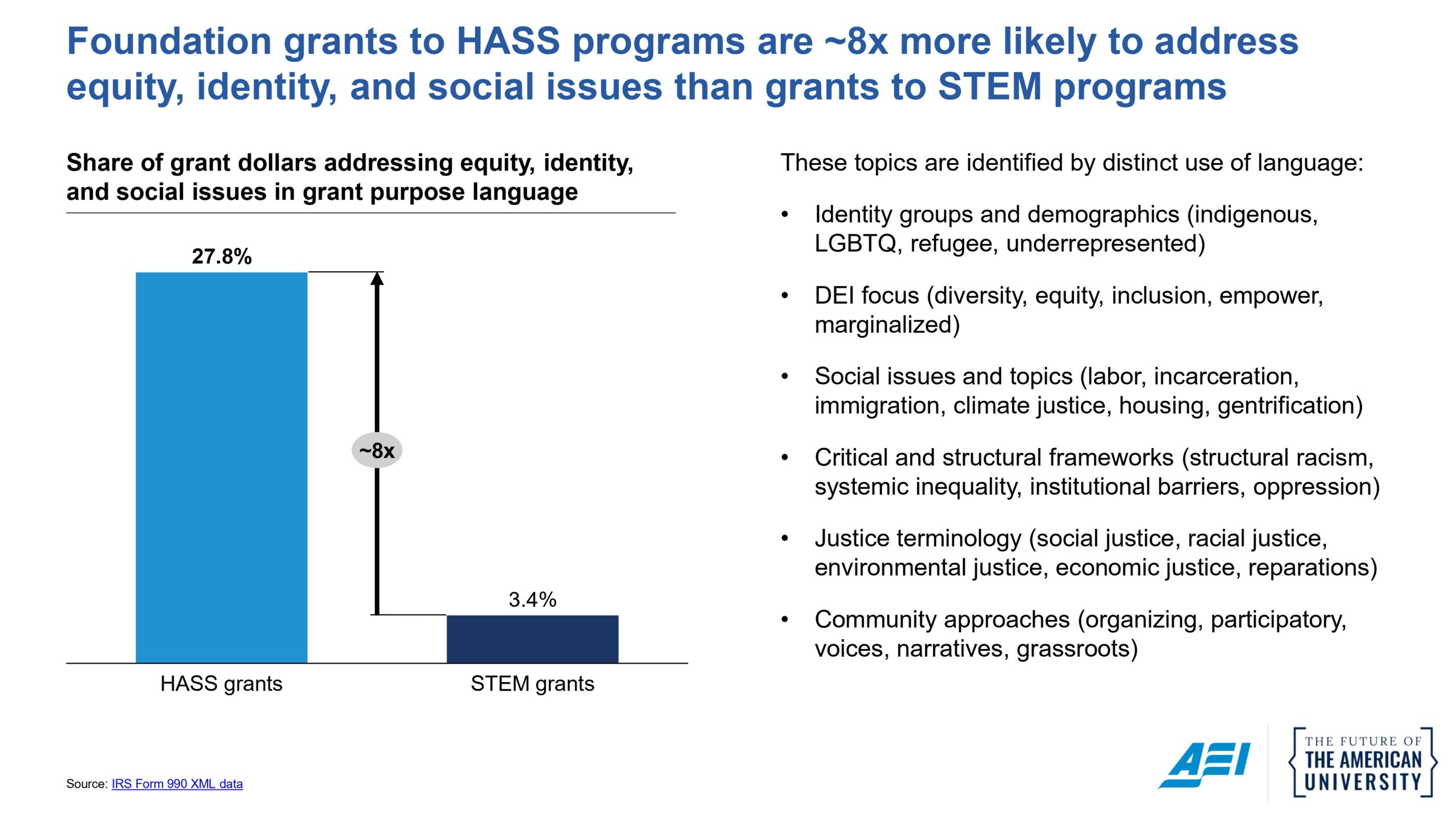
So, what can we discern about the favored topics of the standard-setting foundations? Analysis of HASS grant language using approximately 160 keywords (e.g., equity, identity, social justice) across six themes reveals that progressive topics appear at rates eight times higher than in STEM grants (27.8% vs 3.4%). Parallel analysis using approximately 180 keywords across eight themes typical of conservative scholarship (e.g., free markets, national security, limited government) found that negligible funding was granted in these areas.
These figures likely understate funding for both progressive- and conservative-leaning projects, as the classification relies strictly on disclosed grant-purpose language rather than inferred intent.
Scarcity and concentration create influence, while asymmetry shapes its direction. In resource-scarce fields, institutions providing the “marginal dollar” can exercise influence through selective emphasis, even without funding most of the research. Compounding this influence is selective amplification. Major funders tend to be invitation-only, with foundations identifying scholars already doing work aligned with their priorities and providing resources to amplify it. Rather than changing what scholars want to study, concentrated funding determines which scholars, approaches, and institutions gain prominence in resource-scarce fields.
This dynamic appears in the grant data itself. In addition to supporting scholars directly, more than a quarter of HASS grants went toward supporting infrastructure—centers, institutes, departments, journals, conferences—that can mature into self-sustaining institutional capacity. A supported scholar who can leverage that infrastructure gains advantages in hiring, publication, and influence that compound over time. In fields where alternative funding is scarce, these advantages can be decisive in determining whose work shapes the discipline.
The charts below illustrate these dynamics in practice. Funding tends to cluster around a defined set of themes and terminology, revealing both what is funded, and how funded scholarship is framed and justified. This pattern does not require coordination among foundations; it can diffuse organically through imitation and shared norms within a relatively small philanthropic ecosystem.
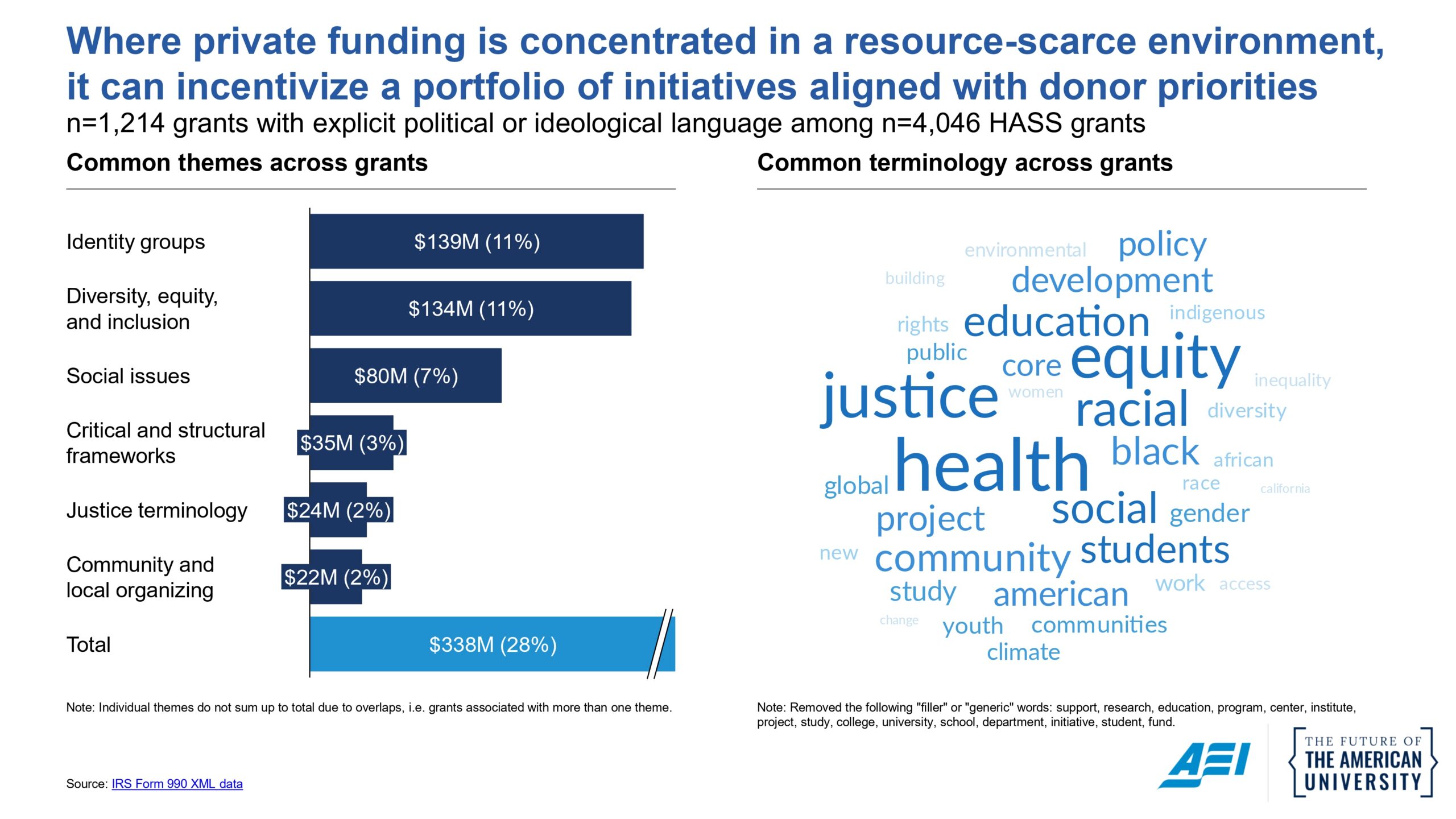
This language pattern is consistent with what some observers describe as a “scholar-activist” approach to research. Under this view, funding is structured less around sustaining fields of study and more around leveraging those fields to advance social priorities. Whether funding initiated this shift or followed it, concentrated philanthropy can reinforce and entrench it over time.
Either way, if this diagnosis is broadly correct, it has implications not only for critics of the current academic landscape, but for anyone seeking to understand how academic culture is shaped and sustained.
Implications and outlook
The humanities, arts, and social sciences have seen a declining share of budgets and student interest in recent decades. But, in the distinctive model of American higher education, they exercise considerable influence over undergraduate education and by extension the formation of the next generation of leaders. Their underinvestment has been a strategic misstep with real consequences for American leadership and civic health.
Some might criticize progressive foundations for subsidizing radical activism. But stopping at that critique would miss the most important point. What these organizations have accomplished is worthy of respect. They saw an opportunity in a resource-scarce environment, invested patiently and strategically over decades, and achieved field-shaping influence. In a free society, those with resources are entitled to support the causes they find valuable. Progressive foundations should fund what they like, and progressive faculty should teach and research what they like, for as long as they find receptive audiences.
Anyone considering how to have impact on academic culture, given the present concentration of private foundation funding in HASS fields should ask the following questions:
- What made the progressive foundation model successful over multiple decades, and what specific lessons can reformers learn from how Mellon, Open Society, Knight, and Ford built their influence? Are there certain norms, incentives, and structures specific to higher education that bear further examination?
- How have foundations without a politically progressive thrust, such as the John Templeton Foundation, the Spencer Foundation, and the now-shuttered John M. Olin Foundation, structured their grants and sought to carve out a position on this landscape?
- Where in the arc of an academic career is external support most critical for scholars working in underinvested fields, and what mechanisms of support are most effective? For example, what role do new centers, journals, and conferences play?
- Should reformers coordinate with existing foundations, partner with existing donors who share their concerns, start a new initiative that would provide necessary flexibility and focus, or pursue several paths simultaneously?
The answers to these questions might constitute a reformer’s playbook. For now, it is enough to understand the terrain: in fields defined by scarcity, concentration creates power, and power shapes culture. Those who wish to influence that culture must first reckon with how it was formed.
Appendix: Data and Methods
All figures in this essay are drawn from the U.S. Department of Education’s Integrated Postsecondary Education Data System (IPEDS), the Internal Revenue Service’s Form 990 archive, and the National Science Foundation’s Higher Education Research and Development (HERD) survey.
A full analysis can be found here, with all assumptions documented and all data sources linked. SQL queries and Python code used to generate the results are included for any reader who wishes to replicate or extend the analysis.
Tagging the grants was done with the assistance of a large language model, first training the model based on manual review, and then iterating and manually refining the data set until all 107,139 grants were tagged. Tagged grants were then manually reviewed for consistency. Tagging was only done when the grant purpose explicitly supported academic scholarship or research in those fields, based solely on the text of the grant purpose and not inferred from the recipient institution or presumed funder priorities, with ambiguous or general-support cases classified as “other.”
These figures likely underestimate total foundation support. In addition to the deliberately conservative approach to tagging, the analysis includes only U.S. foundations with grant reporting requirements, excluding foreign funders and gifts or endowments that, while they may support a specific individual or field, are not reported as discrete grants. However, this limitation is less significant than it appears: only the largest and most sophisticated institutions have grant reporting requirements, and as such are likely the institutions with the resources, strategic capacity, and coordination necessary to achieve field-shaping influence.
Tao Tan