The University Problem
By Roger Pielke Jr.
April 13, 2026
Originally posted as a report on The Honest Broker
Abstract
Public confidence in American higher education has rebounded modestly in 2025 — the first measured increase in a decade — but the numbers remain far below where they stood when Gallup began tracking them in 2015, and the underlying drivers of skepticism have not resolved. This report draws on new polling from Gallup/Lumina and the Vanderbilt Unity Poll alongside a decade of survey data to diagnose what has gone wrong and what it would take to fix it.
The conventional framing — declining university confidence as a Republican problem — turns out to be badly incomplete. Trust in scientific and academic institutions has fallen steeply among Hispanic and Black Americans, among Democrats without college degrees, and among working-class voters of both parties. The one group reporting high and rising confidence in universities is the same demographic from which universities disproportionately recruit their faculty and administrators: highly educated, secular, wealthy, white liberals. That alignment is not a coincidence. It is the core of the problem.
The report documents the dramatic leftward shift in faculty political composition since the early 2000s and traces the institutional mechanisms — above all the NSF’s 1997 “broader impacts” criterion and the post-Bush-era alignment of science with partisan Democratic politics — that reflected a turn from individual faculty advocacy into institutionalized political action. It draws on the author’s nearly twenty-four years as a tenured professor at the University of Colorado Boulder to show what that institutionalization looks like on the ground. And it evaluates the current debate over institutional neutrality, arguing that what universities actually need is not neutrality — an impossibility — but institutional restraint: a strong, enforced presumption against the university as an institution taking sides in external political controversies.
Three steps toward recovery: return to the academic mission, take institutional restraint seriously in practice rather than just in policy documents, and expand access so that universities serve all Americans rather than the narrow demographic whose values they currently reflect.
Introduction: A Rebound, Not a Recovery
After nearly a decade of decline, public confidence in American higher education has ticked upward. The July 2025 Gallup/Lumina Foundation survey found that 42% of Americans now express a “great deal” or “quite a lot” of confidence in higher education — up from 36% in each of the two prior years. The September 2025 Vanderbilt Unity Poll separately found 47% of Americans confident in colleges and universities, with a net positive rating of +32 points.
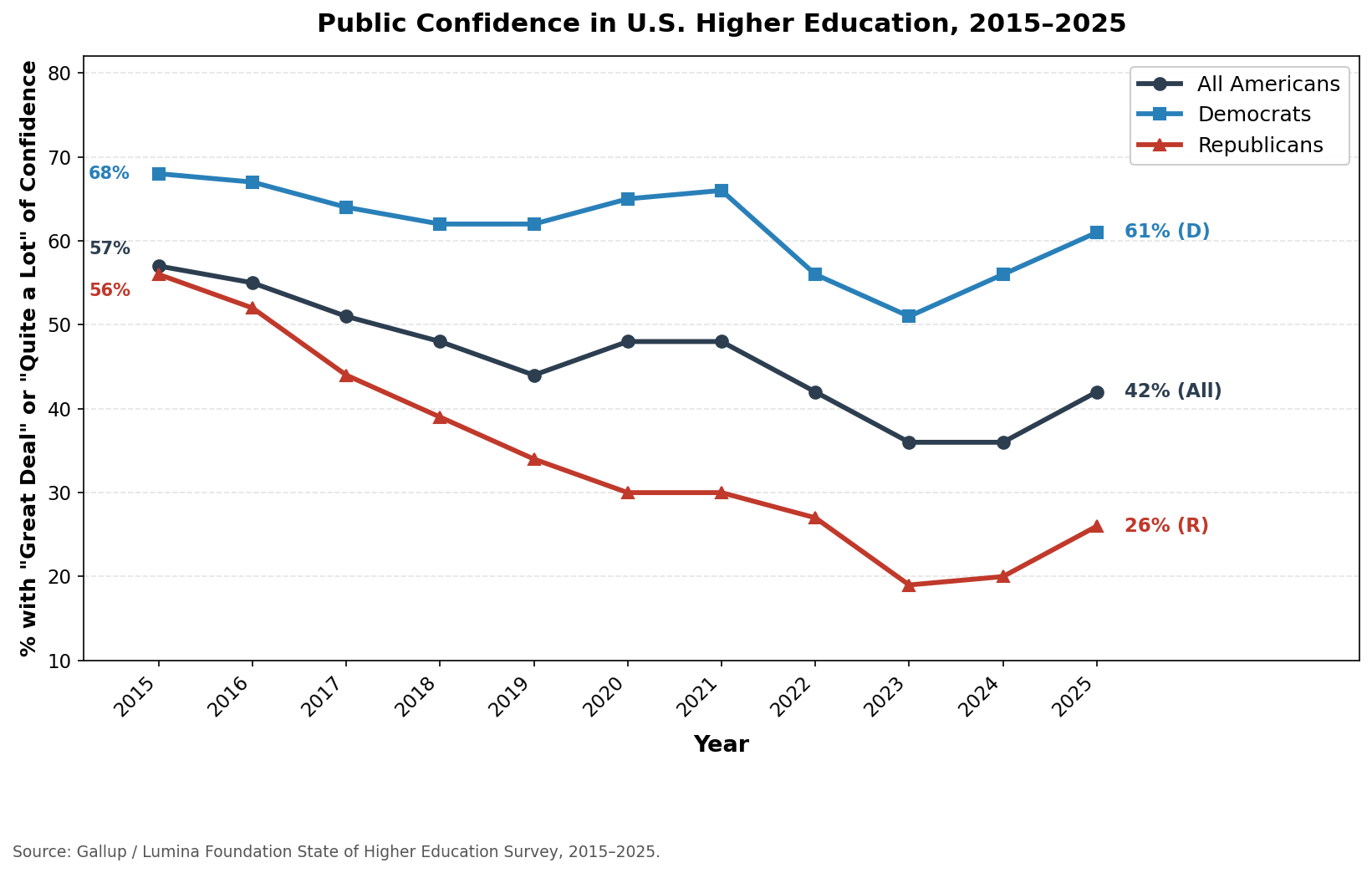
Figure 1. Public Confidence in U.S. Higher Education, 2015–2025. Source: Gallup / Lumina Foundation State of Higher Education
Survey.
In 2015, when Gallup first asked the question, 57% of Americans reported confidence in higher education. Today the number stands at 42% — a net loss of fifteen percentage points accumulated over ten years. The rebound amounts to a six-point recovery from the all-time trough, leaving universities still nine points below where they started and well short of majority confidence.
The Vanderbilt poll finds similarly that Americans today report more confidence in higher education (47%) than in the medical system (38%), the police (44%), or large tech companies (25%). That sounds encouraging, until you notice that most of those institutions have also been losing public trust for years. Higher education is not unique, however the loss of public confidence is nonetheless troubling.
The Partisan Chasm Beneath the Headlines
The modest recovery in aggregate confidence sits atop a partisan divide that has widened enormously over the past decade and has not meaningfully closed.

Figure 2. Partisan Divergence in Confidence in Higher Education, 2015–2025. Upper panel: confidence by party. Lower panel:
Democratic-minus-Republican gap (percentage points). Source: Gallup / Lumina Foundation.
In 2015, the gap between Democratic and Republican confidence stood at 12 percentage points (68% vs. 56%). Today that gap has stretched to 35 points (61% vs. 26%), and has unchanged since 2020.
Democrats recovered somewhat from their recent lows. Republicans recovered barely at all, clawing back six points from their 2023 nadir of 19%. Even those modest Republican gains look fragile: the Vanderbilt poll, conducted two months after Gallup in September 2025, found that among self-identified MAGA Republicans — roughly 20% of the population — confidence in higher education has gone underwater at −7 net.
But here is where the simple partisan story breaks down — and where the real diagnosis gets more uncomfortable. The Vanderbilt data show that Americans across party lines have not rejected higher education wholesale. Large majorities — including 68% of Republicans — still say a college education is “very” or “somewhat” important for a young person to succeed. The erosion has hit confidence in the execution of higher education’s mission, not faith in the idea of it.
Not Simply a Left-Right Story
It is common to see interpretations of declining confidence in universities as a Republican problem — conservatives turning against institutions they never liked, or even reflective of an anti-science orientation of those on the political right. That framing is incomplete.
Consider what the AEI Survey Center on American Life found in its September 2023 survey on public trust in science and scientific institutions. Between January 2019 and May 2023, the share of all Americans expressing confidence in scientists dropped from 86% to 69% — a 17-point collapse in four years. Republicans fell hardest, dropping from 82% to 56%. But Hispanic Americans fell from 82% to 61%, a 21-point drop. Black Americans fell from 85% to 69%, a 16-point drop. And non-white Democrats overall express roughly half the level of deep confidence in scientists that white Democrats do.
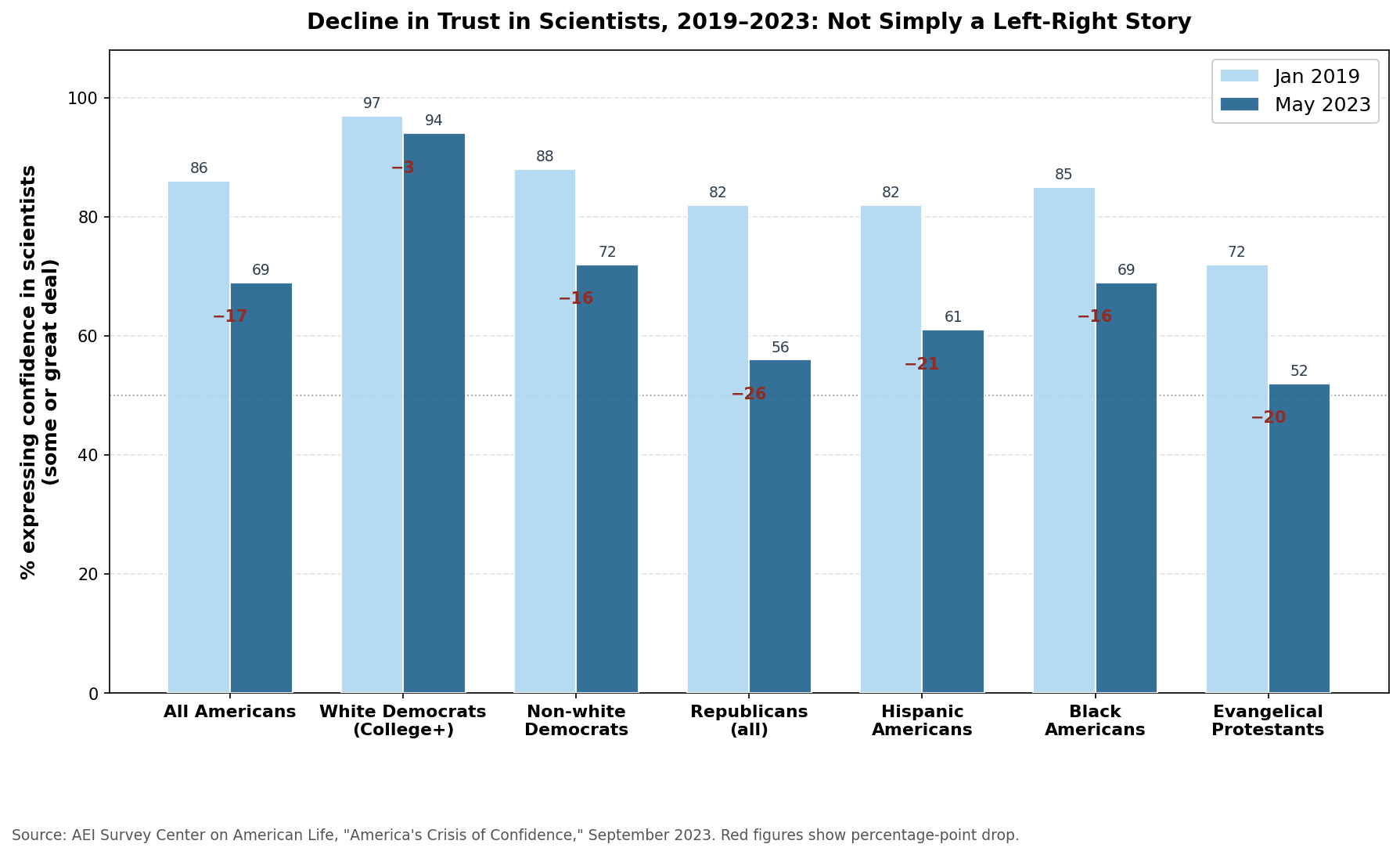
Figure 3. Decline in Trust in Scientists, 2019–2023. Red figures show percentage-point drops. Note the steepest declines among
Hispanic Americans and the significant losses among Black Americans and non-white Democrats. Source: AEI Survey Center on
American Life, September 2023.
The loss of trust cuts across racial groups and, within the Democratic Party, runs along educational lines more sharply than partisan ones. The AEI data reveal a striking finding: Democrats whose highest education is a high school diploma express confidence in science more like typical Republicans than like college-educated Democrats. The educational divide within the Democratic Party actually exceeds the partisan divide between Democrats and Republicans.
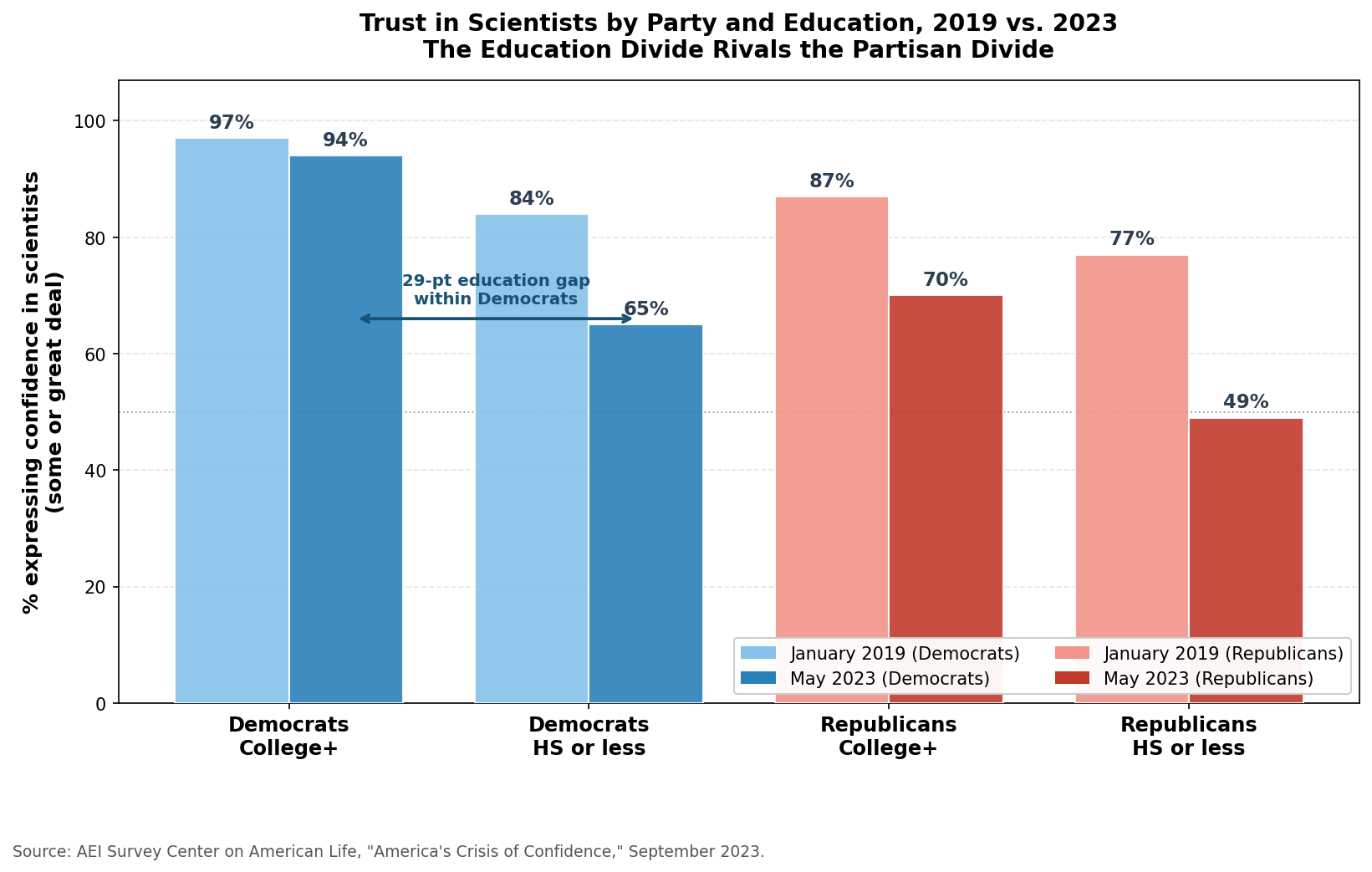
Figure 4. Trust in Scientists by Party and Education, 2019 vs. 2023. Note that Democrats with a high school degree or less
(65%) resemble Republicans overall (56%) more closely than they resemble college-educated Democrats (94%). Source: AEI
Survey Center on American Life, September 2023.
What does this tell us? As I argued in 2023, the scientific and academic community has become demographically exceptional in ways that track closely with political affiliation. Scientists are disproportionately highly educated, relatively wealthy, white, and secular — a combination that over the past three decades has moved steadily toward the Democratic Party.
As researchers Gethin, Martínez-Toledano, and Piketty documented, the stronger the formal education level among U.S. voters, the higher the proportional vote for Democrats — a trend accelerating since the 1980s. Meanwhile, as Michael Zacher documents, affluent Americans — who used to vote Republican — have swung hard toward Democrats.
This matters because scientists and university administrators draw almost entirely from this demographic. When they express values and politics broadly inconsistent with those of most Americans — including most non-white Americans, most Americans without college degrees, and most working-class Americans of both parties — the consequences for institutional trust are predictable. As Dan Sarewitz warned more than a decade ago, the more the scientific community lines up behind one party, the less claim it has to special status in informing difficult political and social decisions.
The 2025 polling data from both Gallup and Vanderbilt substantially confirm this picture while adding a nuance. The Vanderbilt survey finds that 65% of all Americans believe colleges and universities have a positive effect on the country — suggesting that favorable views of higher education in the abstract have recovered more than confidence in its current operation.
But the same survey finds that only 28% express confidence that colleges teach without political bias, and that more Americans locate the source of that bias in administrative decisions (43%) than in classroom instruction (16%). The public has arrived, essentially, at the same diagnosis offered here: the problem traces to institutional leadership and not individual faculty members.
At the same time, when asked if colleges give balanced treatment to right-wing and left-wing viewpoints, 43% of all Americans say they do not — including 71% of Republicans, 38% of independents, and even 22% of Democrats. The comparable 1970 Gallup figure was 32%.
What Americans Think Colleges Do Well — and Where They See Failure
The Vanderbilt Unity Poll offers the most granular recent assessment of what Americans believe higher education actually delivers. The findings reveal a public that discriminates carefully — rewarding universities for specific strengths while registering sharp dissatisfaction with specific failures.

Figure 5. Net Confidence in What Colleges Actually Deliver (% Confident minus % Not Confident). Source: Vanderbilt Unity Poll,
September 2025 (n = 1,030).
Americans award colleges high marks for scientific and medical research (+46 net confidence), humanities and social science research (+28), exposing students to different viewpoints (+25), and preparing students for careers (+22). The public recognizes these as real and valuable functions, and the recognition matters: it shows that the public has not simply written universities off. The goodwill exists. Universities are squandering it.
Two areas register strong negative net confidence. Teaching without political bias: −9 net. Remaining affordable: −48 net — only 14% of Americans express confidence that colleges remain as affordable as possible, while 62% do not. When all respondents were asked what would most increase their confidence in higher education, the top answers converged on three themes: focus on practical career skills, lower costs, and eliminate politics from the classroom.
When Americans identify the source of higher education’s bias problem, 43% locate it in administrative decisions and only 16% point to what professors teach. Americans hold leaders accountable. That should focus the minds of every university leader.
The Evidence on Faculty Politics: Not a Perception Problem
A 2020 survey by Joshua Koss of Michigan State University of tenure-track faculty at 67 AAU member institutions found lopsided partisan imbalance across every major social science discipline. A 2020 analysis by the National Association of Scholars of more than 12,000 tenure-track faculty found that, among those who donated to political candidates, chemistry faculty donated to Democrats over Republicans at a ratio of 113 to 1 — and chemistry sits among the less politicized disciplines in the study. Samuel Abrams’s 2017 analysis showed that the ratio of self-described liberals to conservatives among faculty began a sharp upward climb around 2004 while the same ratio among students and ordinary citizens held roughly constant.
In 1968, a survey found physical scientists and fine arts faculty roughly evenly distributed among Democrats, Republicans, and no party. Even among behavioral scientists, more than 20% reported Republican affiliation. No recent study shows any academic discipline with a majority of faculty characterizing themselves as conservative. The shift has been comprehensive. In 2022, Phillip Magness and David Waugh concluded in The Independent Review that since the early 2000s faculty political identification shifted leftward by roughly 15 percentage points, coinciding with hiring discrimination against non-left applicants and the crowding out of research and teaching by political activism.
Academic freedom is sacred, and individual faculty members remain free to advocate for whatever causes they choose — that goes with the job, and I will defend it unconditionally. The problem does not reside in the personal politics of individual professors.
The problem arises when political advocacy becomes institutionalized — when departments, programs, and entire campuses get repurposed as vehicles for political action on behalf of the faculty’s preferred causes. As I argued in The American Enterprise, the pathological politicization of credentialed expertise is problematic not simply as a matter of politics but because we need to reconcile expertise with democratic politics for society to function.
How We Got Here: The NSF Criterion and the Advocacy Trap
The shift toward institutionalized politicization traces in part to the fall of the Berlin Wall in 1989, which led to challenges to the post-World War II social contract between universities and the public. In exchange for public support, researchers would produce and share knowledge freely for the long-term public benefit. That bargain held while the Cold War provided a unifying rationale for publicly funded science. It frayed when the rationale disappeared.
In 1997, the National Science Foundation rewrote its merit review criteria to make “broader impacts” equal in weight to “intellectual merit.” Among the questions reviewers were asked to apply: “What may be the benefits of the proposed activity to society?” The intent was reasonable. For researchers in narrowly specialized fields — and most researchers are narrowly specialized — the temptation was to demonstrate impact by claiming policy relevance. Most researchers lack training as policy experts. The result: researchers ventured from science into policy and politics in an effort to justify why their work deserved public support.
The George W. Bush years accelerated the trend. Republicans learned they could score political points by taking on experts in politically contentious issues, like climate change. Democrats found they could score political points by accusing the administration of being anti-science. As these battles played out, scientists and the institutions they inhabit aligned increasingly with one party. Dan Sarewitz saw clearly where this led: blurring the boundaries between scientists and politicians, he warned, would not redound to the benefit of politicians but to the detriment of scientists. He was right.
A 2024 preprint by Alabrese and colleagues analyzing nearly 100,000 U.S. academics on X/Twitter found that academics expressed political opinions far more willingly than average platform users, those who did so skewed overwhelmingly to the far left, and those who expressed political opinions suffered a reputational penalty with the public — a penalty many treated as a badge of honor.
What Institutionalized Advocacy Looks Like on the Ground
I spent almost twenty-four years as a tenured full professor at the University of Colorado Boulder. My experiences there offer a case study in how institutional politicization operates when left unchecked.
Between 2016 and 2023, the Boulder Faculty Assembly adopted eight statements and resolutions calling for climate advocacy on campus, culminating in a 2023 resolution demanding that climate change and sustainability become “the central focus of our campus-wide initiatives” and that climate advocacy permeate all CU departments and units. That demand goes well beyond endorsing a scientific consensus — it attempts to convert a state research university into a political organization. The language reads more like a Greenpeace mission statement than anything the Colorado legislature intended when it wrote the university’s statutory mission.
The consequences of the politicization of the academy are significant. A 2024 FIRE survey of 6,269 faculty at 55 major colleges and universities found that nearly half of conservative faculty (47%) feel unable to voice their opinions, compared with one fifth of liberal faculty (19%); a third of all faculty self-censor their written work — nearly four times the share who said the same in 1954 at the height of McCarthyism; and 87% of faculty report difficulty having honest conversations about at least one politically sensitive topic.
When almost everyone in a department shares the same political orientation, orthodoxy hardens, dissent atrophies, errors go unchallenged, and the entire enterprise of free inquiry suffers. The result is precisely what Samuel Abrams warned of in 2017: students go into the world less able to see it as it really is, poorly equipped to defend their own views, and “confused and angered by others who see the world differently.” The national discourse suffers accordingly.
The Institutional Neutrality Debate — and Why It Matters
The most widely discussed response to institutionalized politicization has attracted the label institutional neutrality. In 2024, the Academic Freedom Alliance, Heterodox Academy, and FIRE jointly called on colleges and universities to formally commit to neutrality on contested social issues that fall outside the academic mission. As of 2024, 29 universities had adopted some variant of this stance.
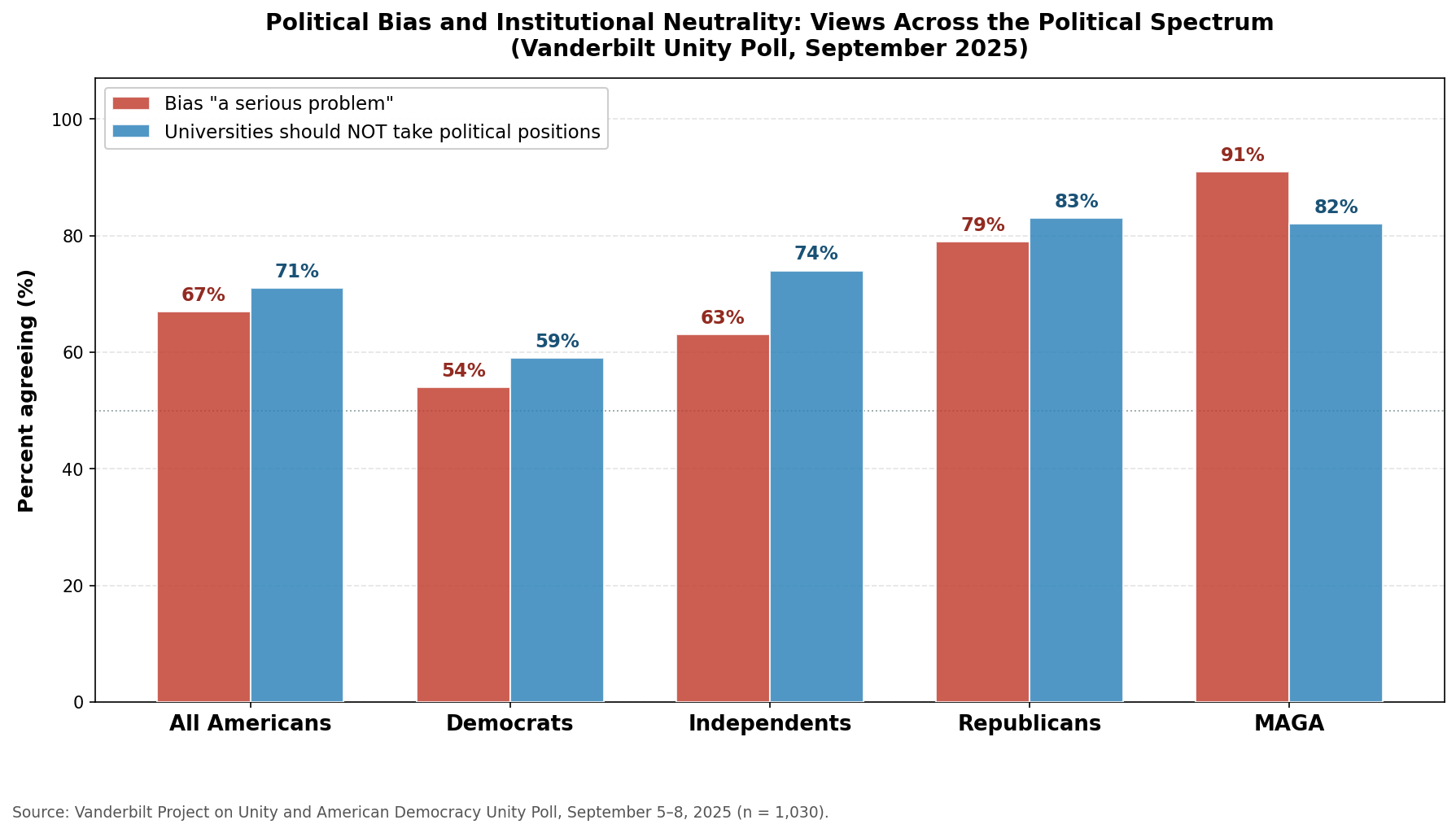
Figure 6. Political Bias and Institutional Neutrality: Views Across the Political Spectrum. Source: Vanderbilt Unity Poll, September
2025 (n = 1,030).
According to the Vanderbilt poll 71% of Americans say universities should not take official positions on controversial political issues. That preference cuts across party lines — 83% of Republicans and 59% of Democrats agree. On few questions about higher education does such broad popular consensus exist.
But institutional neutrality, appealing in the abstract, turns wickedly complex in practice. Full neutrality is simply not achievable — universities lobby Congress for funding, allocate endowment investments according to stated values, and accept mandatory stances through accreditation. What I advocate is something more achievable: institutional restraint — a strong presumption against the university as an institution taking positions on external political controversies.
William G. Bowen, president of Princeton from 1972 to 1988, articulated the case for restraint: Whenever a university takes an institutional political stance, Bowen argued, it compromises its commitment to openness, invites reciprocal lobbying, alienates members of its community, diverts leadership from scholarship and teaching, and erodes the credibility that makes universities unique in society.
A University of Michigan faculty committee that looked at political uniformity on its own campus concluded that creating an environment where “respectful engagement and debate flourishes” represents “a long-term project, one that will inevitably come with setbacks” and “cannot be achieved in one summer or one year.” I agree — Universities have made a serious mess, and the cleanup will take sustained effort from leaders.
Three Steps Toward Recovery
Three actions would move things meaningfully in the right direction.
First: return to the academic mission. Teaching and research are what make a university a university rather than a think tank, a lobbying firm, or an NGO. Clark Kerr’s 1966 observation about the American “multiversity” has only grown more apt with time. University leaders should hold themselves accountable to that mandate and resist the mission creep that converts every department into a platform for the politics of the moment.
Second: take institutional restraint seriously. Not as a press release, but as a governing norm that university presidents actually enforce. That means pushing back against demands — from faculty, donors, and students alike — that the institution take a side in the controversy of the week. It means a hard look at whether existing centers and programs operate with advocacy agendas. There is no shortage of institutions in America advocate loudly for every conceivable political cause. Only one kind of institution, defined by academic freedom, fills the role universities occupy in a democracy.
Third: expand access and serve all Americans. E. E. Schattschneider wrote that “democracy is like nearly everything else we do; it is a form of collaboration of ignorant people and experts.” The great land-grant universities exist because the public decided that higher education should serve the whole nation — not a self-selected, geographically concentrated elite. Today, major universities still justify their prestige partly through selectivity, by whom they exclude. Arizona State University president Michael Crow has pointed toward a different vision: a “national service university” that makes higher education available to the full socioeconomic and intellectual diversity of the country. The latest public opinion data indicates that goodwill exists in the public for universities to reclaim their role.
The Bottom Line
Public confidence in American higher education took a decade-long hit, and the modest rebound of 2025 — while welcome — leaves universities far from where they were and where they need to go. The specific concerns driving skepticism — political bias and unaffordability — have not resolved; the share of critics citing political agendas actually increased between 2024 and 2025, from 28% to 38%.
Universities deserve reform, not demolition.
We need universities to work. And we need them to work for everyone — not just for the subset of Americans who happen to share the politics of the faculty lounge.
Roger Pielke