
How to Influence a University Without Anyone Noticing
By Tao Tan
March 2, 2026
The Mellon Foundation has changed the shape of the humanities and social sciences, as three recent pieces have powerfully shown. Tyler Austin Harper argued in The Atlantic that Mellon’s funding concentration leaves ambitious humanities scholars with little practical alternative to aligning their work with the foundation’s priorities. John D. Sailer pointed out in the Wall Street Journal those priorities explicitly blend scholarship with progressive political activism. And through careful analysis of the funding streams to the humanities, arts, and social sciences (HASS), I showed how a few private foundations, including Mellon, have the capacity to exercise standard-setting power in academia.
But important questions remain. Why did it take so long for people to catch on to Mellon’s influence? How did they and other foundations come to be perceived as natural and legitimate parts of the academic ecosystem, rather than seen as unwelcome external pressure mechanisms exerting power through “outside money?” How did they and other foundations succeed in wielding such influence over the academy without anyone noticing?
The fact is that foundations that have successfully influenced academia have learned to use a set of levers that are precisely calibrated to work effectively within the existing structures of higher education. These levers align with academia’s distinctive norms, work with natural intellectual incentives, and are based in a keen understanding of the organizational psychology within colleges and universities.
These levers are not distinctive to Mellon’s practice, nor are they used only by foundations whose priorities skew to the left. The now-shuttered John M. Olin Foundation successfully pursued variants of this approach from the right for several decades. But major progressive foundations are employing these methods at greater scale, with more patience, and with a sharper feel for how academic systems operate. To be fair, they are “pushing against an open door” in an ecosystem that in many fields is arguably already philosophically in concert with their priorities. But however one feels about the direction of their influence, the strategy behind it deserves respect and invites careful study.
It is tempting, but shortsighted, to caricature foundations as bad actors and scholars as captured. Foundations are within their rights to set priorities and exercise judgment about mission alignment, and scholars have the freedom to choose whether to pursue certain funding streams or not. A more illuminating approach to this topic attempts to understand the “influence architecture” that foundations have built to guide, but not control, the behavior of individual scholars. Scholars who pursue fundable questions that they also genuinely believe are important are operating rationally within a field shaped by largely invisible but highly effective incentive structures.
What follows is a study of that architecture—a picture of ten of the levers that foundations can use to influence scholarship.
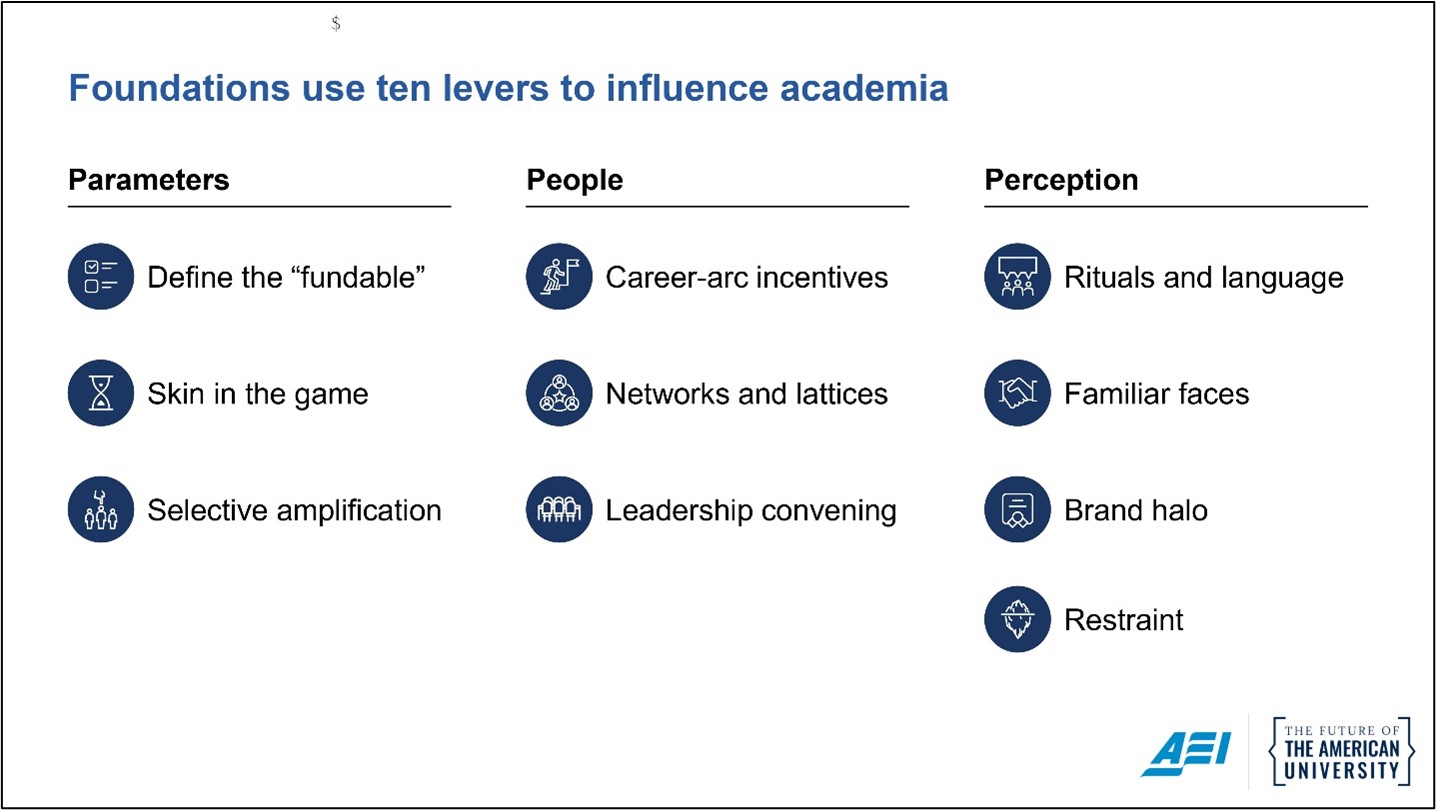
Parameters
1. Define the “fundable.” Foundations do not tell scholars what to study or how to study it. That would be seen as a violation of academic freedom and trigger institutional antibodies. Instead, foundations define what they will fund. But while a scholar remains free to pursue any line of inquiry, in fields where alternative funding is scarce (as in the HASS fields), the practical universe of research narrows to what major funders will support. As previously documented, roughly 80% of disclosed private HASS funding flows from just 25 foundations. When the marginal dollar is this concentrated, funders can set priority topics of research, blurring the line between “we only fund X” and “you should study X.”
2. Skin in the game.Rather than create permanent endowments, which would transfer control to the university, the most effective foundations provide substantial but time-limited support, typically under five years. The expectation is that universities will fundraise alongside the grant or absorb the costs when funding expires. This keeps universities invested in the initiative’s success while preserving the foundation’s leverage. If the work drifts from the funder’s priorities, the grants will likely not be renewed.
3. Selective amplification. More than a quarter of foundation HASS grants support “infrastructure” such as centers, institutes, journals, conferences, and prizes. This is among the most durable forms of influence. The currency of the academic realm—prestige and peer perception—is often earned by visibility. The romantic notion that a good idea will find its audience on merit alone is little more than just that—a fond wish. In practice, funded infrastructure creates the visibility that builds scholarly reputation, which in turn attracts further attention. Young scholars, observing who gains prominence and why, follow these prestige signals and calibrate their own research directions accordingly.
People
4. Career-arc incentives. An academic career is a sequence of gating events: finish the dissertation, secure a postdoc, land a tenure-track job, earn tenure, achieve promotion, enter academic leadership. Each transition is precarious, and modest support at the right moment can be decisive. A fully-funded postdoc can launch a career. A research grant that enables an assistant professor to buy out teaching duties to finish a book right before tenure review can make the difference between continued employment and dismissal. Some start even earlier—providing named chairs for entry-level positions or even supporting undergraduates who might be interested in an academic career: the Mellon Foundation is rightly proud that the Mellon-Mays Undergraduate Fellowship (which is awarded to college juniors) has produced over 1,200 PhDs since 1988, of which more than 800 are now faculty. As Sailer documented, there are scholars whose careers were supported by Mellon funding at every major transition point, from undergraduate fellowship through tenure. Over the arc of a career, each successive award, whether intended that way or not, deepens the implicit sense of dependency and alignment. These are small investments with compounding returns.
5. Networks and lattices. Foundations fund similar initiatives across multiple institutions and actively encourage the grantees to collaborate. This creates natural network effects. A scholar at one institution has potential colleagues, co-authors, and hosts at a dozen others. A PhD student who needs a postdoctoral placement looks to a sister initiative at a peer institution. Over time, these networks become self-reinforcing, generating conferences, co-authored publications, and pipelines that persist beyond any single grant.
6. Leadership convening. Foundations frequently convene newly appointed deans and department chairs. The primary purpose is often skill-building and professional development: how to craft a budget, how to mediate conflict, how to deliver bad (and good) news, how to appoint a search committee. But the structural effect of these convenings is to create mutually supportive peer networks oriented around a specific vision of institutional priorities.
Perception
7. Rituals and language. Successful foundations mirror the rituals of academic life. They describe their processes using familiar terms: competitive grants, peer review, merit-based selection. The language builds legitimacy and makes it look like work is being funded according to the processes of a fair and free market. But many of the grants are invitation-only, with a narrow pool of eligible applicants identified in advance. In some cases, as Harper’s reporting in The Atlantic documented, program officers “tightly coached” applicants on what they had to say to secure funding. The form looks like open-ended, merit-based peer review, but is actually an intentional process of careful curation.
8. Familiar faces. Foundation program officers often hold PhDs in the disciplines they fund. Some are former faculty; others are current faculty on leave. This cuts the cultural distance between funder and funded to nearly zero. A program officer who has published in your field, attended your conferences, and shares your professional vocabulary is not perceived as an outsider, but rather as a peer.
9. Brand halo. Foundation recognition carries considerable weight in the currency of the academic realm. Mellon, Ford, and MacArthur are known brands and recognized signals of scholarly merit. For young scholars, association with a brand enhances a CV in ways that ripple through hiring, tenure review, and peer perception. The brand itself becomes a prestige signal, independent of the content of the funded work.
10. Restraint. The most effective foundations are notably quiet. They do not seek publicity or give interviews. They do not claim credit for their grantees’ work. They do not attempt to pick faculty or dictate content. They understand, correctly, that going beyond this framework would violate academic norms and invite pushback. And they understand that restraint can be the ultimate lever: let all the others do the work for you.
Implications
These levers, pulled in various combinations, enable those foundations to be perceived as natural and legitimate parts of the academic ecosystem, not as unwelcome meddlers. It is distracting to focus on this phenomenon as evidence of an illegitimate conspiracy. It is more helpful to recognize that these networks were built by a generation of talented professionals, dedicated to field-building, who took the time to understand how the academy actually works, down to its rituals and language. This is how strategic, sophisticated philanthropy works.
The leverage that a small number of foundations currently have over HASS fields is a story of scarcity, concentration, and asymmetry. What we are witnessing is something like a tragedy of the commons combined with an accident of history: as governments, universities, and other philanthropists underinvested in the shared intellectual infrastructure of the humanities and social sciences, those foundations that remained dedicated to the task gained outsized leverage over those fields. These foundations didn’t capture a healthy ecosystem; they effectively tended to, and eventually came to dominate, a neglected one.
Anyone interested in shaping the future of the academy, from any direction, should begin by understanding how this was done. And anyone interested in restoring pluralism in the academy will have to start by figuring out both how to incentivize the diversification of funding priorities of the top private foundations and how to start rebuilding a more pluralistic funding ecosystem.
Tao Tan